
Whenever I walk into a pharmacy that sells lubricants, or I’m working in front of the lubricant section of a sex shop, I see almost the same situation: a wall full of options.
Different brands. Large and small bottles. Formulas labeled water based, silicone, hybrid, natural, organic, sensitive, or long lasting. Some are flavored, others promise warming or cooling sensations, and some seem to do exactly the same thing as the bottle next to them.
It is also an area where customers very often need help.
The question is usually:
“Which one should I get?”
My answer almost never starts with a brand.
It starts with another question:
What are you going to use it for?
Because there is no lubricant that is automatically best for everything. What you need depends on whether you want it for masturbation, vaginal sex, anal sex, toys, protected sex, the shower, or perhaps several of those things.
Once we know that, the wall stops being so complicated.
Before choosing: what does lubricant actually do?
The main purpose of lubricant is to reduce friction.
That can make sexual activity more comfortable and pleasurable, but in some situations it also matters for safer sex.
During anal sex, for example, lubrication is especially important because the anus does not produce its own lubrication. A generous amount of lubricant can help reduce friction, irritation, and the possibility of small tears.
If you are using a condom or another barrier, the type of lubricant also matters. Some formulas are compatible with condom materials, while others can weaken them.
So let’s start with the three options you are most likely to see.
Water-based: the most versatile
If someone does not know where to start, a water-based lubricant is usually the simplest option.
It is probably the most versatile category.
It can be used vaginally and anally, works with nearly every common toy material, and is compatible with common condoms. It also washes off easily with water.
So if someone tells me they want to buy one bottle for several different uses, I would probably start by showing them water-based options.
There is also a huge amount of variety within this category.
Some formulas are very thin and light. Others are much thicker and may feel more comfortable for anal sex or for people who prefer the product to stay where it is applied.
The downside?
Water eventually evaporates or gets absorbed.
That means some formulas can begin to feel sticky or lose their glide after a while.
That does not necessarily mean the lubricant is bad.
It may simply mean you need to reapply it.
Even within water-based lubricants, formulas can feel very different, so do not dismiss the whole category because you disliked one bottle years ago.
If you want versatility, easy cleanup, and fewer compatibility issues with toys, water-based lubricant is an excellent place to start.
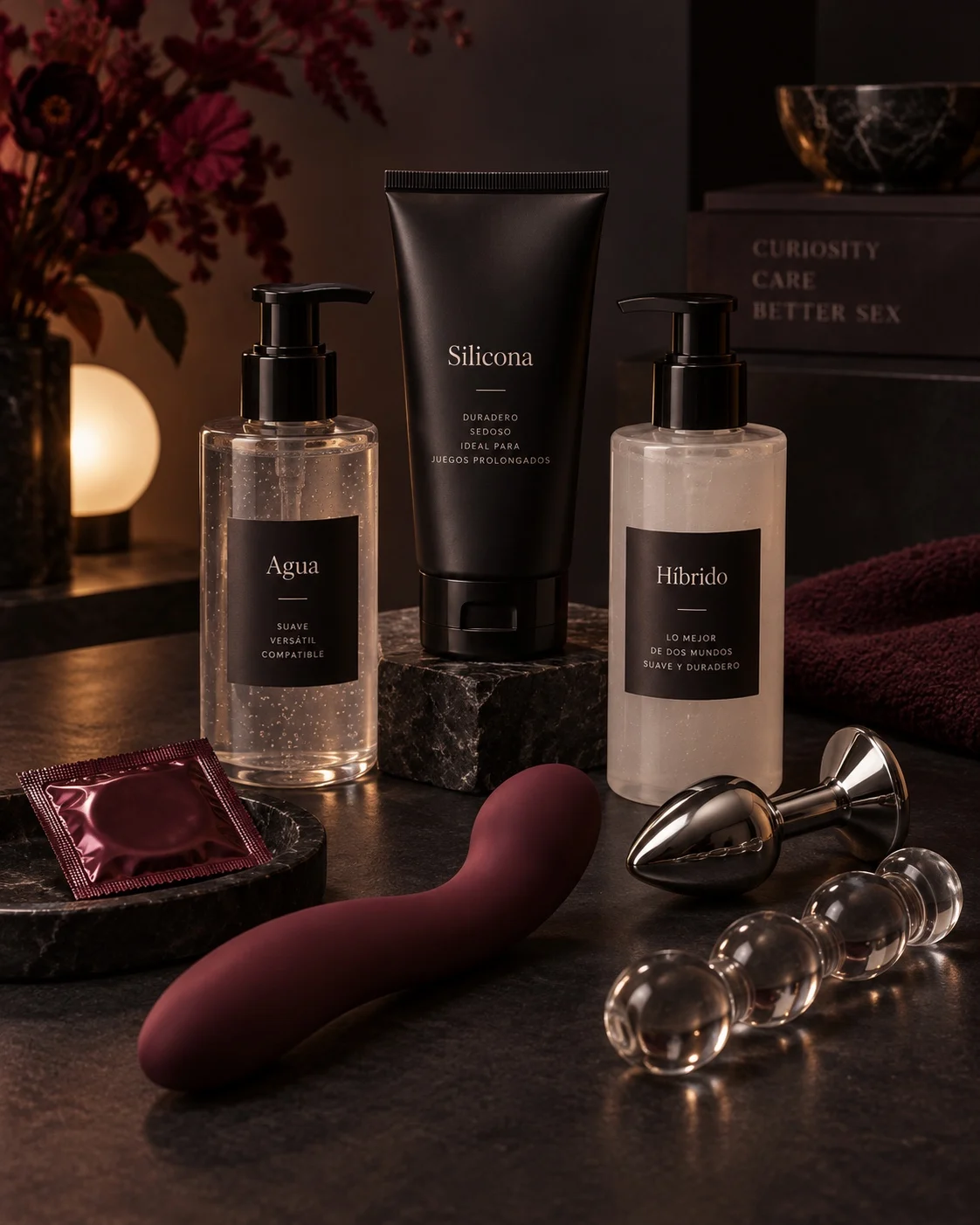
Silicone: when you want it to last
Silicone-based lubricants have one very clear advantage:
they last.
They do not evaporate the way water-based lubricants do, and they maintain glide for much longer.
That can make them especially useful for anal sex, longer sessions, or situations where you do not want to stop repeatedly to reapply lubricant.
They also have another interesting advantage: they work much better around water.
If you are thinking about the shower or bath, a water-based lubricant is literally competing with all the water around you. Silicone stays on the skin much better.
And yes: silicone lubricants can be used with latex condoms.
The problem usually appears when toys enter the picture.
Silicone with silicone
If a toy is made of silicone, I would not assume that every silicone lubricant is safe to use on it.
Certain combinations can damage or alter the surface of the toy.
So if you do not know exactly what the toy is made of or what the manufacturer recommends, there is a simple solution:
use a water-based lubricant.
With stainless steel, aluminum, hard plastic, or durable glass toys, you do not have the same silicone-on-silicone compatibility concern.
There are also products and manufacturers that specifically approve certain combinations. If both the lubricant and the toy explicitly say they are compatible, follow the manufacturer’s instructions.
The important thing is not to guess.
Hybrids: a little of both worlds
Then we get to hybrid lubricants.
A hybrid lubricant usually combines water with silicone ingredients.
The idea makes sense: keep some of the easy cleanup and feel of a water-based formula while using silicone to extend the glide.
In many hybrid formulas, the amount of silicone is lower than in a fully silicone-based lubricant.
That can make hybrids appealing to people who feel water-based lubricant dries too quickly but who do not want the feel or cleanup of a fully silicone formula.
But there is an important caution.
The word “hybrid” does not automatically mean it is compatible with everything.
Not all hybrid formulas contain exactly the same ingredients or proportions.
So I would not determine compatibility simply by thinking, “It only has a little silicone, so it should be fine.”
If you are using it with a silicone toy or a specific barrier, check what the product says.
With hybrids, reading the label matters even more.
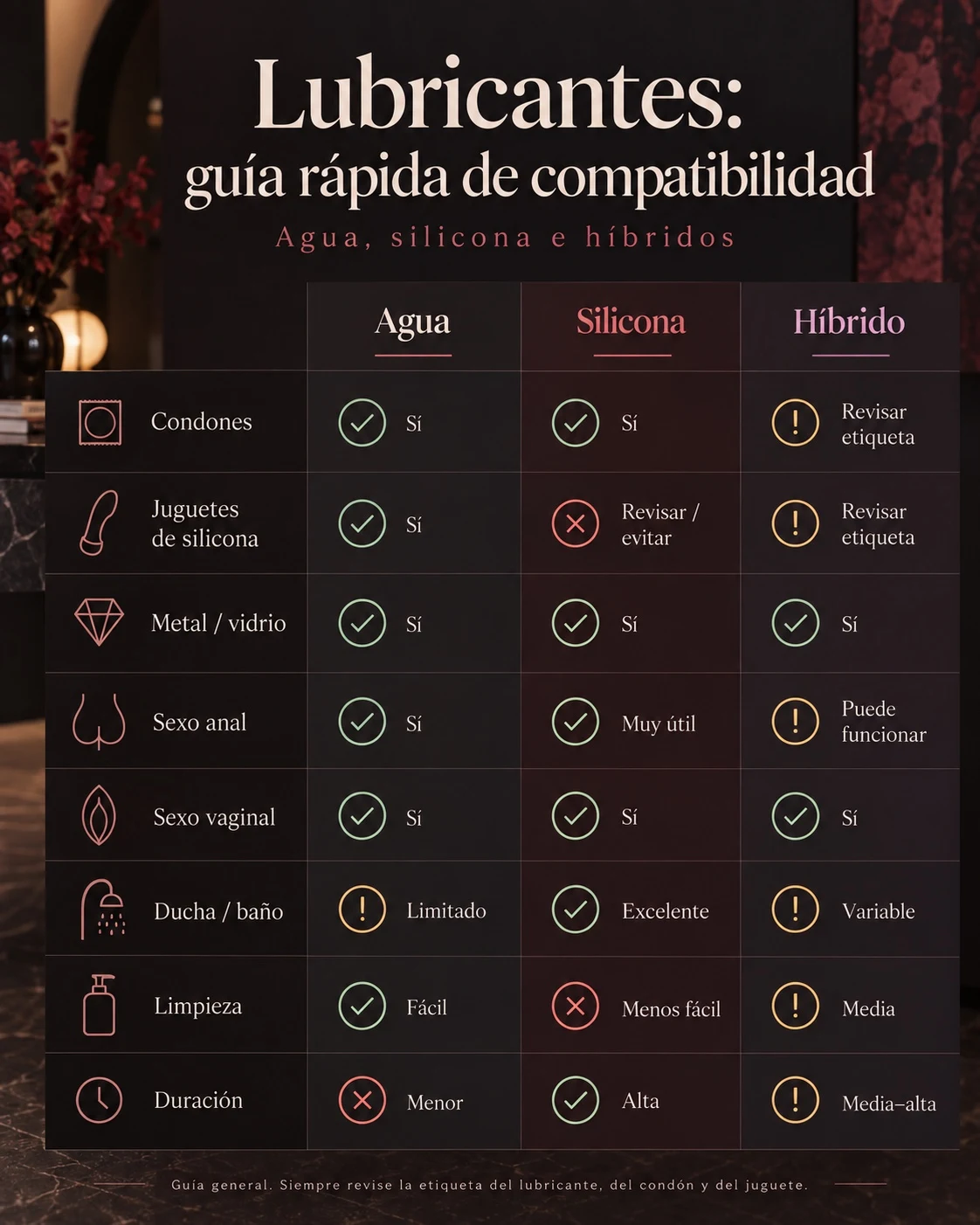
Which should you choose for anal sex?
I get a lot of questions about this.
And there really is not one single answer.
For anal sex, what we mainly need is good lubrication and enough staying power.
A water-based lubricant can work perfectly well, especially a thicker formula designed to stay in place.
Silicone has the advantage of lasting much longer and usually needs fewer reapplications.
That can make it especially useful for anal sex.
But now add another variable.
Are you using a silicone toy?
Then a water-based formula may be more convenient.
Is the toy stainless steel or glass?
Silicone can be an excellent option.
Are you using a condom?
Water- and silicone-based lubricants work with latex condoms, but it is still good practice to check the lubricant package and the condom package.
Also, any toy designed for anal penetration should have a wide base or another feature that prevents it from being fully drawn into the rectum.
That detail matters much more than the color of the toy.
What about vaginal sex?
Both water- and silicone-based lubricants can be used vaginally.
Here, personal preference matters a lot.
Some people want something very light. Others prefer a thicker texture. Some want it to wash away easily afterward, while others want it to last a long time.
But there is something worth understanding:
the words “water based” do not tell you the whole story.
Two water-based lubricants can have different ingredients, viscosity, pH, and osmolality.
The World Health Organization and UNFPA have technical specifications for personal lubricants that consider characteristics like these.
In other words, the base helps classify the product, but it does not determine the quality of the entire formulation by itself.
If a formula causes persistent burning, itching, pain, or irritation, stop using it.
What about oil-based lubricants?
I left them out of the three main categories on purpose.
Not because they are necessarily bad.
For massage and masturbation, they can be excellent. They often provide a lot of glide and can last a long time.
The issue appears when certain protective barriers are involved.
Oils can weaken latex and polyisoprene, increasing the chance that condoms made from those materials will break.
Some condoms made from other materials may be compatible with oil-based lubricants.
But again:
do not guess.
Check the package.
If you use latex condoms and want to keep things simple, use a water- or silicone-based lubricant.
If you share toys, change the condom
Since we are talking about toys and lubricants, there is another recommendation worth mentioning.
If a toy is shared between people, putting a condom over it can help reduce the exchange of fluids and microorganisms.
But that condom should be changed before the toy is used with another person.
You should also clean the toy appropriately or change the condom before moving a toy from the anus to the vagina.
This is not simply about whether the toy looks clean.
The goal is to avoid transferring microorganisms from one area of the body to another.
Using a barrier on a toy can also be useful in some situations involving compatibility between toy materials and lubricants.
Take advantage of testers
This is one of the things I recommend when someone is shopping in a specialty store.
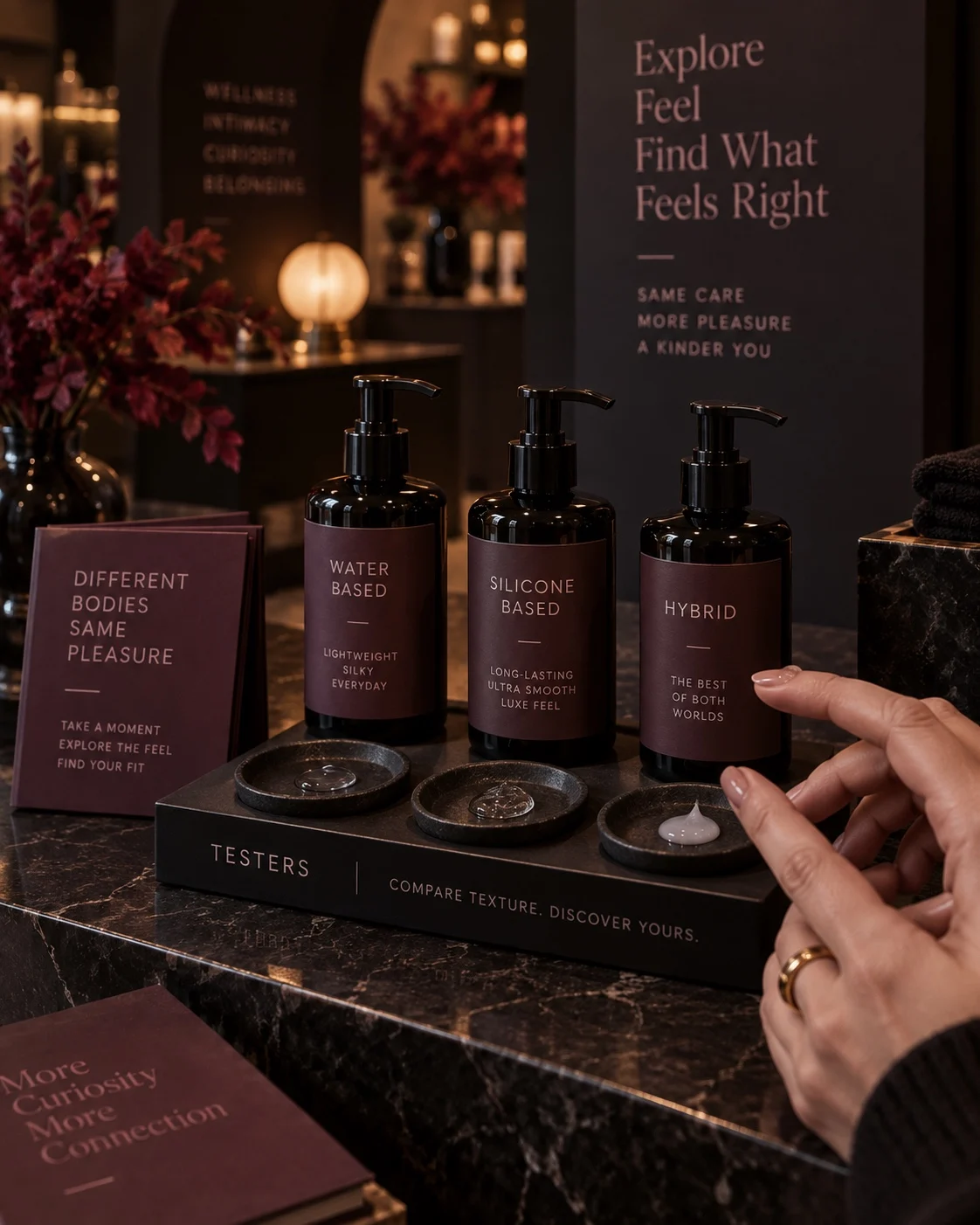
Many sex shops have testers for several formulas.
Use them.
I do not mean applying them to the genitals.
Put a small amount on your fingers or the back of your hand and compare them.
Words like silky, ultra smooth, natural feel, or long lasting can sound great on the package, but they do not necessarily tell you how the product actually feels.
Pay attention to simple things:
How does it glide?
How thick is it?
Does it become sticky after a few seconds?
Does it disappear quickly?
Can you clearly feel a difference between that formula and the one next to it?
Buying lubricant is one of those situations where touching a tester can tell you more than reading ten adjectives on the box.
And if you are in a specialty store and still have questions, ask.
That is part of what the staff is there for.
“Natural,” “organic,” “sensitive,” and “hypoallergenic”
Then there are all those words printed on the front of certain bottles:
Natural.
Organic.
Sensitive.
Vegan.
Hypoallergenic.
Glycerin free.
Paraben free.
Some of those characteristics may be exactly what a person is looking for.
But I would not assume that a word printed in large letters automatically means the lubricant is better for everyone.
One person may tolerate a formula perfectly while another experiences irritation.
If you know you have sensitivities, look at the ingredient list and directions, not just the marketing claim on the front.
And remember that “natural” also does not tell you whether a product is compatible with your condom or toy.
Those are different questions.
In front of the wall: four questions
The next time you find yourself in front of that wall of bottles, you do not need to memorize fifty products.
Ask yourself four questions:
- What am I going to use it for? Masturbation, vaginal sex, anal sex, massage, toys?
- Will I be using a condom or another barrier?
- Will I be using a toy, and do I know what material it is made of?
- What matters most to me: easy cleanup, durability, or versatility?
With those four answers, you have probably eliminated a large part of the wall.
If you want something that works with almost everything, start with water-based lubricants.
If you need more staying power, look at silicone.
If you want something in between, explore hybrids and read the label.
And if testers are available, try them.
In the end, this is not about finding the best lubricant.
It is about finding the right lubricant for what you want to do.