I grew up and have spent much of my life in Latino environments, and there are things I have heard so many times that they almost become background noise: men don’t cry, you look like a girl, that’s for women, that’s gay.
I am not saying every Latino man thinks this way, or that this is unique to our culture. I am speaking from my own experience: family, friends, acquaintances, customers, and conversations I have heard over the years. For many men I have known, being a man seems to have come with a long list of things you are supposedly not supposed to do, feel, or allow.
And I think that education follows us into bed too.
Curiosity that seems to be allowed in only one direction
There is something I have always found interesting.
Among heterosexual couples, it does not surprise me to hear a man say he wants to try anal sex with a woman. Some women want it too, suggest it themselves, and genuinely enjoy it. Of course they do. But I have also known and heard women talk about doing it mainly to please a partner, because he is curious, because they believe it turns him on especially, or because they feel —explicitly or not— that being more open to certain things may help keep his interest.
I am not trying to turn that personal experience into a statistic. It is simply something I have seen and heard repeatedly.
What I see much less often is the conversation going the other way.
Her asking him: Do you want me to try a finger? Do you want me to stimulate your anus? Do you want us to explore your prostate? Do you want to try oral-anal stimulation —rimming, whatever term you prefer?
For some men, that is where the conversation stops being only about pleasure.
Other questions appear: What does that say about me? Is that gay? Does that make me less masculine? Why would I want to receive if I’m the man?
And to me, that is one of the most interesting parts of talking about anal exploration.
Sexual orientation and anatomy are not the same thing
A heterosexual man can enjoy having a woman stimulate his anus or prostate and still be heterosexual. A sexual practice, by itself, does not tell us who someone is attracted to.
That may sound obvious when written out, but culturally we do not always treat it as obvious.
There is qualitative research specifically on heterosexual men and receptive anal stimulation. Researchers found men who were able to talk about that pleasure and, in some cases, explore it without understanding it as incompatible with being straight. The same work points out that confusing anal receptivity with homosexuality can become a barrier both to exploration and to receiving accurate sexual education.
There is also research on how masculinity is constructed among some Latino boys. One ethnographic study involving Dominican and Puerto Rican youth in the United States observed that, within that particular group, part of masculine identity was built by distancing oneself from homosexuality and reinforcing heteronormative expectations. That does not mean “Latino men are like this.” It means that something I have seen many times in my own life has also been observed and studied in specific contexts.
My experience is still my experience. I do not need to turn it into a universal rule in order to talk about it.
Your prostate does not need an identity statement either
The prostate sits below the bladder and in front of the rectum. Cleveland Clinic explains that it can be felt through the anus at roughly two inches —about 5 centimeters— inside, toward the front of the body.
So if a clinician can feel it during an exam with a gloved, lubricated finger, it should be fairly clear that prostate stimulation does not require starting with something enormous.
There is nothing wrong with wanting a large plug or a penis-shaped dildo. If that is what you want and you know how to use it appropriately, fine.
But it is not a requirement for finding out whether you enjoy the sensation.
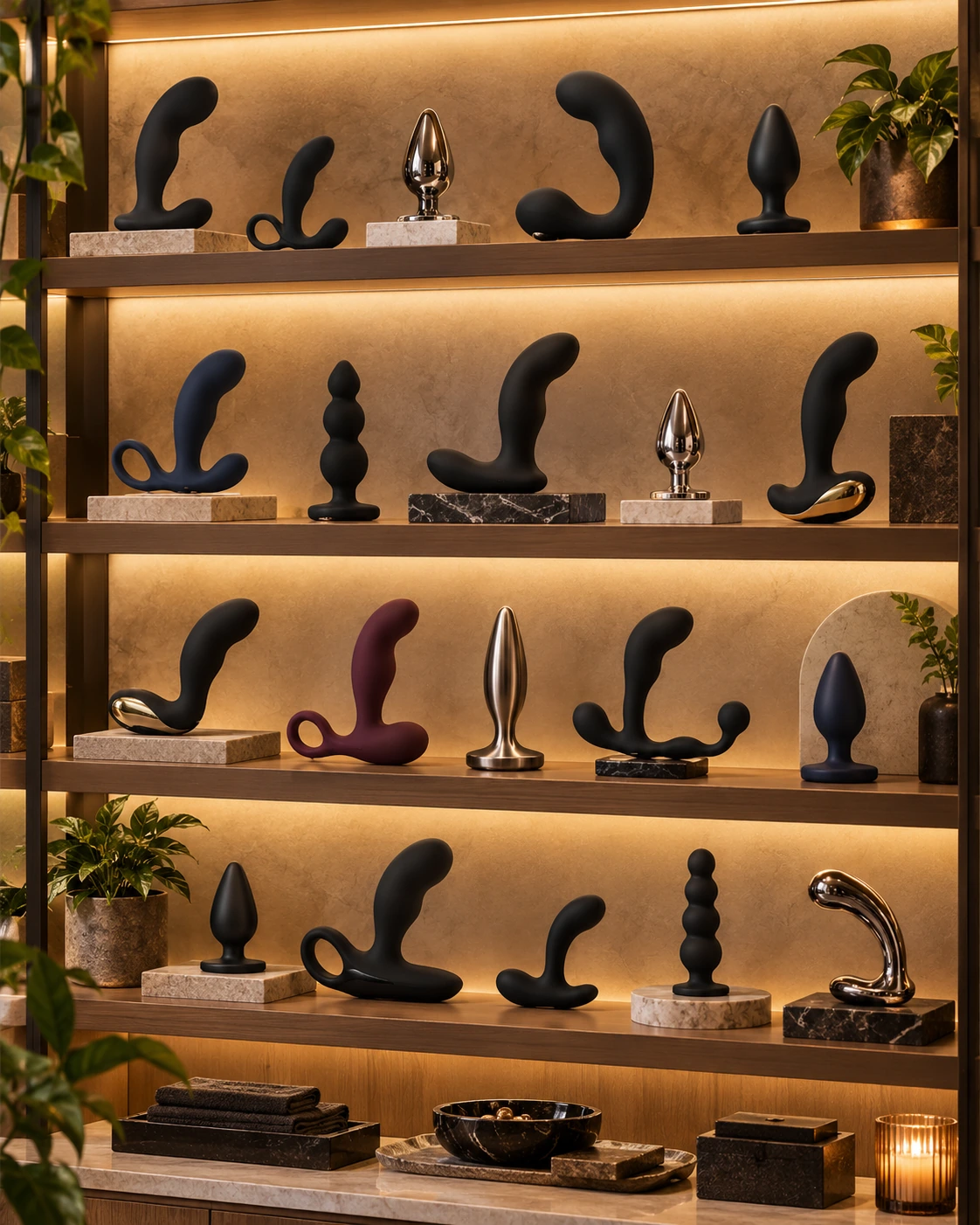
A clean, lubricated finger, a small prostate massager, or a moderately sized anal toy with a secure flared base can be much simpler starting points. And someone may enjoy stimulation around the anus without wanting penetration at all.
Anatomy gives us possibilities. Not obligations.
The same rules can show up among gay men
This does not automatically disappear when we talk about gay men either.
I have seen and heard versions of the same hierarchy: being a top associated with being more masculine; receiving associated with being feminine. Sometimes it shows up as a joke, and other times it becomes a real judgment about another man’s masculinity.
Research involving gay and bisexual men has also found cultural associations between being a top and masculinity, and between being a bottom and femininity. Other work has documented bottom shaming directly: stigma toward men who enjoy or express a preference for the receptive role.
I have always found that particularly interesting.
A person may have challenged one enormous cultural rule by accepting that he is attracted to other men and still carry other rules about what a man is supposed to do with his own body.
Top, bottom, and versatile can describe practices or preferences. They are not a masculinity scale.
I am not writing this from a pedestal either
I am mostly gay. There is some fluidity in my case, although it leans very heavily in one direction.
And I am also not someone who can claim to have tried absolutely everything. My own receptive anal experience has been limited, and my body has something to say about that. That is another subject that may deserve its own conversation when we talk about physiology, comfort, or health.
I mention it because I do not want to replace one rule with another.
I am not saying every man should try prostate stimulation. Not enjoying it does not make you closed-minded. Enjoying it does not make you more evolved.
Some people try something and love it. Some try it and do not see what the fuss is about. Some enjoy one kind of anal stimulation and dislike another.
All of those responses are valid.
What I do think is a shame is dismissing something you are genuinely curious about only because someone taught you that a man should not enjoy it.
A couple, some lubricant, and a small plug
Recently I helped a couple who were looking for lubricant for anal sex.
I showed them different possibilities: a thicker water-based formula, silicone options, and a few hybrids. We talked about longevity, texture, and how the choice changes depending on what they actually want to do.
Eventually they became interested in a small, inexpensive plug.
During the conversation I realized that I had initially been speaking to him from the role that seemed most obvious: as the person who would be penetrating. So I made a point of doing something deliberately. I told him that he could use the plug too. That they could both explore.
I do not know who the toy was for.
After they left, I found myself thinking that maybe it had always been for him and he simply had not wanted to say so. Or maybe it was for her. Or for both of them.
It really does not matter.
What matters to me is that they knew they could tell me.
You do not have to give me a more acceptable story
I want anyone who talks to me about these things to know that they do not need to invent a different explanation for why they want something.
If you are an adult, the other person is an adult, there is consent, and we are talking about a practice that can be done with reasonable attention to safety, my job is not to judge you.
You can tell me what you want to try, what sensation you are looking for, what worries you, and who the product is for. I can recommend something more intelligently if I understand what you actually need.
That does not mean I need an intimate account of your sex life either.
There is a difference between having enough information to guide someone and making them feel as though they have to confess.
Sometimes all you need to say is: It’s for me, I’ve never done this before, and I want something small.
Perfect. We can start there.
If you want to try, start small
Your first experience does not need to become an endurance test.
For any anal penetration, lubrication matters especially because the anus does not produce the lubrication needed for penetration on its own. Planned Parenthood recommends using plenty of lubricant, starting with smaller sizes, and using toys designed for anal use with a flared base or another feature that prevents the toy from being pulled completely inside.
I also prefer to avoid products that numb the area when someone is learning. Pain is information. If something hurts, it makes more sense to reduce intensity, add lubricant, change the angle, or stop —not simply make yourself unable to feel it.
Go slowly. Communicate. Stop if it hurts.
And remember that “I didn’t like it” is also a completely valid result.
Lubricants: water, silicone, or something in between
If you are still unsure which base makes sense for you, Mulberry already has a full guide: In Front of the Lubricant Wall: Water, Silicone, or Hybrid?.
For anal exploration, I would usually start by comparing a thicker water-based formula with a long-lasting silicone formula.
JO H2O Anal Thick — water-based
A specifically thicker water-based option for anal use. The published formula includes water, glycerin, and thickening agents, does not use desensitizing ingredients, and is designed to provide more body and cushioning than a light water-based lubricant. Because it is water-based, it is also the simplest choice when you want to avoid uncertainty about compatibility with silicone toys.
pjur BACK DOOR Silicone Anal Lubricant — silicone-based
An alternative when longevity and fewer reapplications are the priority. Silicone stays slippery much longer than most water-based formulas. If you are using a silicone toy, check the toy manufacturer’s instructions before combining the two.
Sliquid Sassy — water-based, thick gel
Another water-based option with a dense gel consistency. Sliquid formulates it without glycerin, fragrance, flavor, or numbing agents; the brand specifically positions it for anal play and states that it is compatible with toys and condoms.
You do not need any of these three products specifically in order to explore. They are simply examples of three reasonable ways to think about the choice: thicker water-based, long-lasting silicone, or an especially dense water-based gel.
More options on the menu
I often say, half seriously and half jokingly, that I am a little jealous of people who can try new things without turning every experience into an existential crisis.
It is like being someone who eats everything: you have more options when you open the menu.
That does not mean you have to like everything. It means you can try, decide, and keep what you actually enjoy.
In sex, having more possible ways to experience pleasure should never obligate you to use any of them.
But you should not have to be afraid of discovering them either.
Maybe the most liberating part of experimenting is not finding a new way to have an orgasm. Maybe it is discovering that your body is not required to obey every rule you learned about what a man should or should not feel.
You can try. You can say no. You can enjoy it and do it again. You can decide it is not for you.
None of those answers makes you more or less of a man.
And none of them, by itself, decides who you desire.
Receiving can also simply be pleasure.